
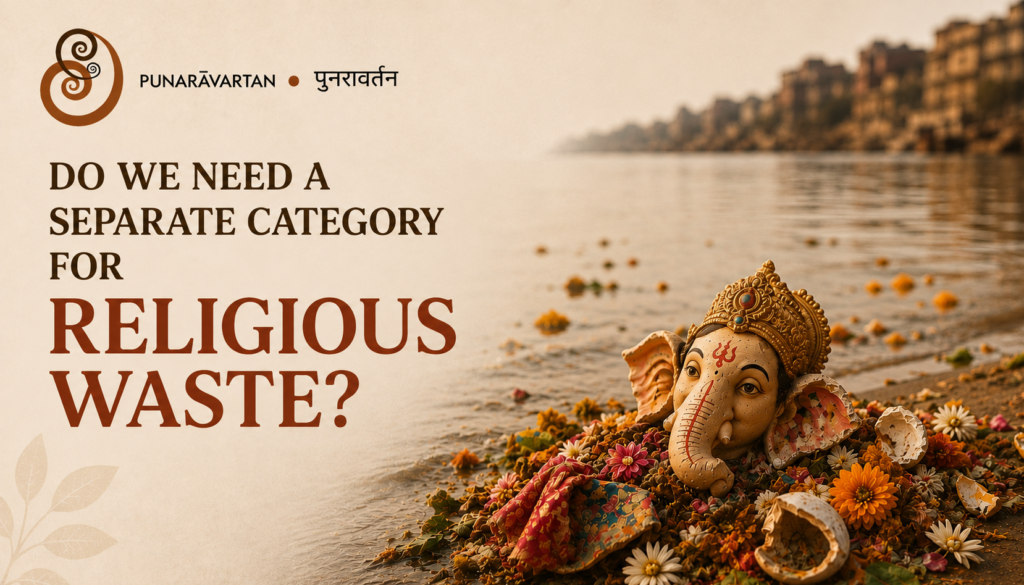
Do we need a separate category for Religious Waste?
Sruthi Darbhamulla and Manisha Sheth
Festivals are joyous large-scale public events. Ganeshotsav means dhol tasha, idols, puja, immersion- a colourful and eventful few days. And then the aftermath. Like all public events, a vast quantity of waste is generated. One part of this is religious waste, which is difficult, sensitive material to process and dispose of.
Most religious ritual traditions started with the use of natural material. In principle they were respectful of Nature’s forces and cycles.
Rituals were a medium through which humans deepened their connection to Nature in the physical realm as well as spiritually.
The reason for waste generated by religious ritual is threefold – the widening gap between human society and Nature, the introduction of industrial materials, the loss of meaning and significance of ritual. Additionally, the attempt to change or reinterpret ritual becomes difficult when the original meaning of the ritual is not alive and often people hold onto the outward form more staunchly. In many cases the leftover materials are not considered as ‘waste’ as they continue to hold the energy and intention of the prayer and ritual performed.
Several types of religious waste are generated, some easier to handle than others:
- Iconographic item: idols, photographs, symbols on paper, plastic or cloth
- Organic ritual material: Flowers, leaves, food offerings, coconut shells
- Inorganic ritual material: Threads, incense sticks, plastic utensils, covers, boxes, chemical paints, metallic objects, glass, thermocole.
There is already a legal framework in place for dealing with general waste. The Environment (Protection) Act, 1986 provides broad directives to prevent waste disposal that could be detrimental to the ecosystem.
Specific categories also get specific directives. That is why we have The Hazardous Wastes (Management, Handling and Transboundary Movement) Rules, 2008, The Plastic Waste (Management and Handling) Rules, 2011, and the Solid Waste Management (SWM) Rules, 2026.
Again, to deal with pollution, we have The Water (Prevention and Control of Pollution) Act, 1974, also amended in 2024, as well as The Air (Prevention and Control of Pollution) Act, 1981. Delhi has a specific legislation: The Commission for Air Quality Management in the National Capital Region and Adjoining Areas Act, 2021.
Some general principles have seeped into public life: municipal corporations enforce waste segregation, and every industry is acquainted with the “Polluter pays” principle.
But there is no definite law for anything considered sacred, which may be a bit of an oversight in a country rich with religious tradition and ritual.
The Festival of Ganesh Chaturthi
A case in point is the debate around the use of Plaster of Paris idols for the Ganesh Chaturthi festival. In earlier times, when the idols were made with natural and biodegradable materials, immersing them in natural water bodies was not as harmful to the ecosystem. As the scale of the festival grew, natural clay was replaced by Plaster of Paris and these do not disintegrate in water.
In 2010, the CPCB issued guidelines which banned the production of Plaster of Paris idols and also banned any immersion in natural water bodies. This issue is far from settled, however. Only some areas have instituted the ban; Maharashtra recently told the Bombay High Court that it needs THREE more years to phase out PoP idols. The issue has now been in public and legal debates for over three decades. The challenges faced in solving this issue illustrate how complex the matter of religious waste can be.
So how can we dispose of religious waste during Ganeshotsav?
Urban local bodies provide spaces to dispose of Nirmalya and other waste near immersion sites. If we use clay idols, the clay sludge can be recycled through campaigns such as Punaravartan
Paper and plastic items can be reused. As with much else in life, however, prevention is better than cure. If we use eco-friendly products where we can and implement a circular approach where use of non-renewable resources is unavoidable, we can help save the earth a little more every festive season.
The shadu maati used to make Ganesh idols can be collected and used again by artisans. We can reduce what we take from nature by creating smaller circular loops of renewal and reuse. Ideally when an idol is bought from an artisan the clay should be returned back to him directly by the citizen.
And we can prevent putting back more toxins too, by avoiding toxic products and not immersing our idols in natural water bodies.
What clues can this example give us about how religious waste can be sustainably managed?
A Separate Category
In a sense, if the material continues to hold value to the worshipper this has to be respected in the way it is managed after disposal. Systems of collection, dismantling and disassembly should ensure handling with care. Sometimes the religion may also have a ritual to disinvest the product or material of the belief for e.g. in some Hindu rituals the divinity is invoked at the start of the ritual and revoked at the end of it.
However, the community who is practising the ritual and producing the religious waste should be involved in its disposal as well. Through such engagement perhaps there would be a willingness to revisit the materials and products used when they see the final disposal challenges. A partnership between the religious community and the government would engage both together in the conservation of the natural environment.
In this way, a separate category of religious waste may endure that tradition, belief and Nature are all respected.